Thursday, March 03, 2005

Plastic bottles pile up as mountains of waste

Do you know that the Plastic Bottles is a Petro-Chemical Product??

It would take 1,000 years to dissolve??

& the gasses release into the air would cause Air pollutions.

& the remain would contaminating the Ground.

Think about the Great Health of our future Generation..
We need to put the action together.


Plastic bottles pile up as mountains of waste
Americans' thirst for portable water is behind drop in recycling rate
By Miguel Llanos Reporter MSNBC
Updated: 1:30 p.m. ET March 2, 2005

The biggest growth in bottled beverages isn't beer or soft drinks or juices. It's tasteless, colorless and sugarless water. And while that can mean fewer cavities and slimmer waistlines, it irritates Patricia Franklin to no end.

The director of a nonprofit group that promotes recycling, she spends her workday thinking about the bottles, cans and other container waste that most Americans take for granted.

The boom in plastic water bottles has her especially frazzled because while the recycling rate is extremely low, the demand from recyclers is actually quite high.

Franklin, who runs the Container Recycling Institute, doesn't blame individuals as much as what she feels is a recycling system that hasn't kept up with consumption patterns — especially when it comes to water.

Bottled water is the single largest growth area among all beverages, that includes alcohol, juices and soft drinks. Per capita consumption has more than doubled over the last decade, from 10.5 gallons in 1993 to 22.6 in 2003, according to the Beverage Marketing Corporation.

The growth has been even more impressive in terms of water bottles sold: from 3.3 billion in 1997 to 15 billion in 2002.

But most bottled water is consumed away from home, usually at a park, in an office or even while driving — areas where there's usually no recycling.

"The opportunities for recycling outside the home are minimal," Franklin says, "and therein lies the problem."

Bottles by the numbers
Only about 12 percent of "custom" plastic bottles, a category dominated by water, were recycled in 2003, according to industry consultant R.W. Beck, Inc. That's 40 million bottles a day that went into the trash or became litter. In contrast, the recycling rate for plastic soft drink bottles is around 30 percent.

The low water bottle recycling rate also impacts the overall recycling rate of all plastic, or PET, products. That's fallen from 53 percent in 1994 to 19 percent in 2003.

Plastics should be recycled so that less petroleum — a finite commodity — is consumed, Franklin says.

"The environmental impacts are in the drilling of the oil," she adds, noting that burning fossil fuel also releases gases that many scientists tie to global warming.

A second reason for recycling, Franklin says, is the litter factor. While plastic water bottles are not a significant percentage of overall waste, the empties are certainly all around us visually.

Thirdly, she says, is the fact that the domestic plastics recycling industry faces a shortage because so much is being exported to China for recycling there. That shortage has also led to fears that some companies will go bankrupt.

"There is a means to reclaim these bottles and use them to make new bottles and other products at home," Franklin says, "but they (recyclers) simply can't get enough of the containers to do it."

Strategies
The Container Recycling Institute thinks a nationwide bottle deposit law would create the incentive to recycle, especially when it comes to plastic bottles, and ease the burden on taxpayers, who pay for cleaning up litter.

"A national bottle bill, or producer responsibility bill, could turn it around and shift the costs from government and taxpayers to producers and consumers," Franklin says.

States with deposit laws already recycle four out of five bottles, Franklin notes, thanks in part to an army of recyclers — from Boy Scout Troops to office cleaning crews — that turns one person's trash into their income.

Eleven states have bottle bills but they are a patchwork with no two alike, she adds, and only three states, California, Hawaii and Maine, include plastic water bottles in their laws.

A national law, she says, should cover new containers that didn't exist 20 years ago, e.g. plastic water bottles, and enforce a dime-per-bottle deposit "as it is in Michigan, where deposit containers are recovered at a rate of 95 percent."

But while deposit legislation has had varying degrees of bipartisan support in Congress over the years, it has never become law.

Franklin blames opposition from the beverage industry, saying its campaign contributions have given it "incredible political clout in Congress and actually in every state legislature in the country."

Beverage industry opposition
That opposition certainly exists, but the beverage industry says it just doesn't make sense to force a deposit law on consumers.

"This cost burden placed on businesses is also passed along to consumers — levying a 'hidden tax' on both," the American Beverage Association said in an issue statement on the topic.

Curbside recycling at homes and businesses, as well as educating consumers, are the best methods for dealing with container waste, the group adds.

Tom Kinnaman, an economics professor at Bucknell University in Lewisburg, Penn., believes that while recycling is expensive the debate needs to reflect what he calls the "happiness" value of seeing litter cleaned up.

Factor that in and a deposit law can make sense, says Kinnaman, whose research includes household recycling trends.

"It turns out recycling also provides utility," he says. "It benefits society because it provides happiness for people in excess of what it costs to provide the happiness."

High tech, low tech
A Colorado company called Biota says it might have a way around the deposit controversy: a biodegradable bottle. All of Biota's water bottles are made out of the biodegradable plastic, which comes from corn starch in a process developed by the seed company Cargill and Dow Chemical.

Biota says that while traditional plastic bottles can take 1,000 years to degrade in a landfill, its bottles can biodegrade within 80 days in a commercial composting operation.

Won't the bottles dissolve on store shelves? Biota says they'll only degrade if they've been emptied and placed in composting conditions — high heat and humidity as well as microorganisms to eat away.

Biota is just getting off the ground, selling to a few health food stores in California, Colorado and Nevada. But it plans to expand, and even sell via the Internet.

Franklin sees hope in the biodegradable plastic, but adds that a big, unanswered question is whether mixing those bottles with PET bottles might contaminate the latter in the recycling process, making them useless.

"The concern is if we are going to be able to transition to that type of plastic what will be some of the impacts on companies that are trying to recycle PET bottles out there," she says.

And what about a low-tech approach of just educating the public to assume more responsibility, taking those plastic bottles home to a recycling bin instead of leaving them in a trash bin at a park?
MSNBC - Plastic bottles pile up as mountains of waste

Tuesday, March 01, 2005

New York appeals court says new farm manure rules not protecting water

All Things have the Positive Views & Negative View. The following statement from the court is the right facts.

The farms, it added, can generate each year millions of tons of manure, which carries potentially harmful pollutants including pesticides, bacteria, viruses, trace elements of arsenic and compounds such as methane and ammonia.

When properly applied, manure can be spread on fields and serve as fertilizer. But improperly applied, the court said, it can pollute.


These not mentioned about the treatment to the manure & the waste water after treatment issues.. certainly these is manure issue must treat with care, otherwise the ground water on earth would be further polluted. thus for our Drink water.

For the Great Health of our people Drink Water Safety is the Number priority.

FARM SCENE: New York appeals court says new farm manure rules not protecting water
By LARRY NEUMEISTER Associated Press Writer
February 28, 2005, 9:51 PM EST

NEW YORK -- A federal appeals court on Monday agreed with environmentalists that new federal clean-water rules were not protecting the nation's waters from the manure pollution of large farms.

The 2nd U.S. Circuit Court of Appeals in Manhattan said it agreed with environmentalists who claimed in lawsuits that the rules failed to provide meaningful review of plans developed by the farms to limit the pollution.

The appeals court said the rules imposed in February 2003 by the Environmental Protection Agency were arbitrary and capricious and did "nothing to ensure" that each large farm was complying with requirements to control the pollution.

Its ruling requires the EPA to make changes so it can ensure compliance by the farms with the Clean Water Act, which includes "the ambitious goal" that water pollution be eliminated. It also said the agency must provide a process that "adequately involves the public" as it creates a new system.

Robert F. Kennedy Jr., president of the Waterkeeper Alliance, an international grass-roots organization connecting and empowering 129 local water protection programs, said he was grateful that the court had rebuked "the government and the barons of corporate agriculture."

"These regulations were the product of a conspiracy between a lawless industry and compliant public officials in cahoots to steal the public trust," Kennedy said in a release.

A telephone message for comment left with the EPA in Washington, D.C., was not immediately returned Monday.

The appeals court noted the average large farm raises 10,000 sheep, 55,000 turkeys or 125,000 chickens and the largest can raise millions of animals.

The farms, it added, can generate each year millions of tons of manure, which carries potentially harmful pollutants including pesticides, bacteria, viruses, trace elements of arsenic and compounds such as methane and ammonia.

When properly applied, manure can be spread on fields and serve as fertilizer. But improperly applied, the court said, it can pollute.

The appeals court rejected some claims by the environmentalists, including that the EPA failed to consider the best technologies to control pollution or that certain costs of pollution control can be demanded of farms because costs can be passed to consumers. It said the EPA had adequately explained that "farmers are at the bottom of a long food marketing chain, subject to imperfect market conditions."

It also noted that the EPA had done extensive data collection, visiting more than 116 large farms in more than 20 states, attending conferences, meeting with trade associations and accepting about 11,000 public comments on its new rules.

The EPA rules require large confinements _ defined as having at least 1,000 beef cattle and 2,500 swine _ to obtain water pollution permits every five years. Some medium ones _ with 300 beef cattle and 3,000 swine under 55 pounds _ may be required to get one. Different head count thresholds are set for livestock operations including sheep, chicken and turkeys.

Any farm required to have a permit also must have a plan spelling out how it will manage manure. Farmers are required to file annual reports summarizing their operations.

Forty-five states manage the program themselves while activities in Alaska, Idaho, New Hampshire, Massachusetts and New Mexico and in the District of Columbia are managed by the EPA.

Newsday.com: FARM SCENE: New York appeals court says new farm manure rules not protecting water

Sunday, February 27, 2005

Drinking Water Supplier Wins Bronze Medal

While congratulating Metropolitan's - SouthLand Water Supplier for the achievment..

However, there is still far more room to improve & achieve 1st if possible.

The Drinking Water Standard cannot be lower or Maintence, it have to be upkeep forever.


Southland's Major Drinking Water Supplier Wins Bronze Medal at International Water Tasting Competition

LOS ANGELES--(BUSINESS WIRE)--Feb. 27, 2005--The drinking water that's coming soon to all Southern Californians received the third-place bronze medal Saturday at the International Water Tasting competition.

Metropolitan's prize-winning water was drawn at its Henry J. Mills Treatment Plant at Riverside, the first of MWD's five treatment plants that has been retrofitted with the ozonation method of water disinfection that produces better-tasting water.

"We're delighted to be recognized again for the outstanding quality of our water," said Metropolitan board Chairman Wes Bannister, "and also to have our first ozone treatment process receive this kind of validation."

Not that the water that 18 million Southland residents currently receive from Metropolitan's other plants is less-delectable. Samples taken at other locations in recent years have won first- and second-place medals at the annual tasting competition held in the historic spa town of Berkeley Springs, W. Va.

However, the characteristics of other local and imported waters, and the effects of local and household water pipes, may affect the taste and scent of homeowners' tapwater.

Metropolitan's water imported from Northern California and the Colorado River comprises about half the drinking water used in a 5,200-square-mile area covering portions of Los Angeles, Orange, San Diego, Riverside, San Bernardino and Ventura counties. Metropolitan's 26 member public water agencies use the imported water to supplement, or in place of, local water supplies -- mostly ground (well) water.

"The ozone disinfection process that we are using at the Mills plant will be on-line at our Jensen plant in Granada Hills this summer, and at our plants in La Verne, Yorba Linda and Murietta by December 2009," said Metropolitan interim CEO Gilbert Ivey. "Metropolitan's board has made a $750 million commitment to ozone retrofits at all of our plants in order to maintain the high quality of our drinking water."

A safe, colorless gas with a pleasant, fresh scent, ozone is a form of oxygen. It is bubbled through drinking water to destroy potentially harmful organisms and also to reduce unpleasant tastes and odors. Ozone, which has been used for disinfecting drinking water since the 1800s, is also noteworthy because it causes fewer potentially harmful byproducts than chlorine.

The water-tasting competition at Berkeley Springs is held annually on the weekend closest to the birthday of George Washington, who was one of Berkeley Springs' early real estate speculators and surveyors. The hot sulphur springs that Washington and his friends hoped would become a tourist attraction are still flowing.

Twenty-nine cities from the United States and several other countries sent entries to the contest, where water samples are judged in the same manner as wine tasting. Metropolitan's water competed against entries from Maryland, Ohio, Colorado, Florida, New Jersey, Wisconsin and New York and other states, as well as entries from Canada and New Zealand.

Carbonated and sparkling bottled waters, and water bottle packaging and design also have their own categories in the event.

In the Municipal Water category, Metropolitan took third place, tying with Rice Lake, Wis. Water from Town of Gibsons, BC, Canada, was judged best in the world; Daytona Beach, Fla., won best in the United States, and Putaruru, New Zealand, placed second.

Metropolitan's entry was selected by its Flavor Profile Panel, a group of employees at MWD's Water Quality Laboratory who are trained in wine-and-beverage-tasting methods. The FPP meets several times weekly -- sometimes daily -- to test water samples from throughout Metropolitan's aqueduct, treatment plants and pipelines.

Their objective is water lacking in noticeable tastes or scents -- the same characteristics that impressed the judges at Berkeley Springs.

The Metropolitan Water District of Southern California is a cooperative of 26 cities and water agencies serving 18 million people in six counties. The district imports water from the Colorado River and Northern California to supplement local supplies, and helps its members to develop increased water conservation, recycling, storage and other water-management programs.
Gmail - Google Alert - Water

Saturday, February 26, 2005

Dirty water, sanitation kill thousands daily-experts

During my travel to those countries like Bangadesh.. Sri lanka, Africa, Indonesia, China.. rural area.. my observation is that the drinking water problem seem to be more serious than what when I am escorted around.

So 4,000 Children died per day due to un-save drinking water is believed to be under stated!!

It need the authorities in respective countries to work hand in hand with WHO to enforce the safety water standard.

As well as the public awareness & education program.

Safe & Clean Drinking Water for Great Health for All.


Dirty water, sanitation kill thousands daily-experts
25 Feb 2005 00:01:00 GMT Source: Reuters
By Karin Strohecker

LONDON (Reuters) - Unsafe drinking water and poor sanitation kill 4,000 children every day, global health experts said on Friday.

They described the deaths as a "silent humanitarian crisis" and called for immediate action.

"There should be an outcry, from the health community above all, for immediate, concerted efforts to confront the reality that sanitation coverage rates in the developing world barely keep pace with population growth," said Dr Jamie Bartram, of the World Health Organisation (WHO).

Four out of 10 people around the globe do not have access to a simple pit latrine and one-fifth have no source of safe drinking water.

"Far more people endure the largely preventable effects of poor sanitation and water supply than are affected by war, terrorism and weapons of mass destruction," Bartram said in an article in The Lancet medical journal.

The report was published as part of a review of the Millennium Development Goals, a number of pledges set out in 1990 to improve living conditions in developing nations by 2015.

But the researchers said realising the goals of eradicating extreme poverty, creating primary school education and reducing child mortality would be difficult without solving the water problem.

Half of all hospital beds in the world are filled with people suffering from water-related diseases such as malaria, diarrhoea and trachoma, an eye disorder, according to the report.

Tackling the problem means addressing it from all sides.

Bartram pointed to the fragile balance between development and safety when creating reservoirs and irrigation schemes. Crop watering systems can improve nutrition but they also provide a fertile breeding ground for diseases.

"Improving irrigation to avoid standing or slow-moving water and improving disposal of household wastewater can reduce mosquito breeding and transmission of malaria," he said.

Reuters AlertNet - Dirty water, sanitation kill thousands daily-experts

Friday, February 25, 2005

Calcium in the Trash, Not the Glass -- Beware of R.O. Filter System

This report subject is relevant here.

It made me think about the R.O. Filter System for the Home Drinking Water.

I used to have the R.O. System installed in my home, then later I found that the R.O. system actually filter off 6-8 Gallon of water to get one gallon of drinking water.

Also, the R.O. Filter system filtered off most of the trace minerals. including calcium.

So, my advise is that if possible don't use the R.O. filter for your Drinking Water system.

Otherwise you need to select the right supplements to replenish it for your Great Health.


Calcium in the Trash, Not the Glass
Thursday February 24, 12:00 pm ET
- Study Finds Fortified Drinks Don't Deliver What's Promised -

BERKELEY, Calif., Feb. 24 /PRNewswire/ -- Everything from soy to orange juice is fortified with calcium these days. But a new study recently published in Nutrition Today* finds that up to 75% of calcium added to popular beverages, like soy drinks and orange juice, gets left at the bottom of the carton. Researchers concluded that existing nutritional labels of these fortified drinks are likely to mislead consumers promising more calcium than they actually deliver.

"This study is really important for people who rely on these beverages to get their calcium every day," states Dr. Celia Brown, MD/Family Practitioner, Woodland Hills, CA. "These findings suggest that in doing so they may be throwing away more calcium than they actually drink."

The three-person medical panel at Creighton University who conducted the study found that -- despite vigorous shaking - -the calcium added to fortified soy and rice beverages settled to the bottom of the container. They concluded that regular hand shaking -- per label instructions -- was not enough to adequately suspend the bone-building nutrient so that it could be consumed. A hardware store paint shaker would be needed for that the researchers found.

Conducted by Creighton's Osteoporosis Research Center, the study compared 14 calcium-fortified beverages (soy, rice, orange juice, etc.) to unfortified, fat-free milk. Of all beverages studied, the research concludes that milk is the most reliable source of calcium.

"This study sheds light on an issue of great public concern as many Americans -- especially kids -- aren't developing adequate bone mass," says Brown.

Over the last 20 to 30 years, there's been a shift away from milk as the standard drink at meals. Government studies show an alarming 86% of teen girls and 64% of teen boys aren't getting enough calcium daily - lacking the equivalent of four glasses of milk per day.**

Research Highlights

- The quality of calcium-fortification in soy/rice beverages and orange
juice is uneven, and may confuse consumers as to the actual calcium
content and benefits.

- Milk scored higher than eight of the 10 orange juice brands and all
four of the soy and rice beverages.

- The study found that milk was the most reliable calcium source and
delivers what the label promises.***


About Dr. Celia Brown, M.D.

Dr. Celia Brown is a graduate of Cornell University, and UCLA Medical School. She is Board Certified in Family Medicine. She currently practices in Woodland Hills, California where she does general Family Medicine. Dr. Brown teaches on the UCLA clinical faculty. She is author of a book of general medical tips for the public, entitled, Doctor's Little Book of Answers.

For more information or a copy of the study contact:
Molly Ireland at 310-226-8600 or 310-455-1160
or e-mail at: molly.ireland@rlpublicrelations.com


* Heaney, RP et al. Not all calcium fortified beverages are equal.
Nutrition Today. 2005; 40(1): pp-pp.

** www.nichd.nih.gov/new/releases/calcium_crisis.cfm?from=milk

*** Scores compare calcium suspension in liquids.

Calcium in the Trash, Not the Glass

Thursday, February 24, 2005

Water For All News

I am putting these Newsletter for All To share.

You can see & feel yourself the important of the concern the Water issues.

Do care to download PDF documents for additional info.


News from Water for All

Stockton gets a failing grade
At the City Council meeting on Dec. 7, the Concerned Citizens Coalition
of Stockton released to the public the first Annual Service Contract
Compliance Review covering the first phase of OMI-Thames 20-year, $600
million water privatization contract in Stockton, California.

The Review details changes to the contract that benefit OMI-Thames: water
rates for Stockton residents have risen two years in a row due to the
contract; customer service requirements have been unfulfilled; a number
of staffing positions are filled with temporary or interim employees;
unaccounted for water has risen from around 3.5% under municipal
operation to nearly 7.5% under private operation; maintenance tasks are
backlogged and finally, OMI made an unauthorized dump of chlorinated
water into an irrigation canal that resulted in a $125,000 fine from
the State Water Resources Control Board. Perhaps this is why the champion
of this privatization, former mayor of Stockton Gary Podesto, failed in
his bid to win a state Senate seat.

The Concerned Citizens' lawsuit challenging the privatization deal is
still pending before the state appeals court. California Attorney
General Bill Lockyer recently filed an amicus brief in support of the
Citizens claims that the City of Stockton violated the California
Environmental Quality Act by not conducting the environmental review
required by state law. For more information see www.cccos.org


Water report from the World Social Forum
The issue of water, defending and protecting this vital natural
resource for humankind and the planet, was a key topic at the World
Social Forum (WSF) in Porto Alegre, Brazil in late January. More than
32 workshops were organized including large open sessions at the
beginning and end of the WSF where a draft global water action platform
was debated.

Public Citizen,along with many other organizations in the
inter-American water activist network (Red VIDA -Vigilancia
Interamericana para el Derecho y Desarrollo del Agua) and from Europe
organized workshops focusing on the role of the World Bank in promoting
water privatization, a speak-out on formulating a UN Treaty on water, a
special workshop to build solidarity for the struggle in El Alto,
Bolivia, a strategy session to plan for the World Water Forum in Mexico
City and much more.

There were many opportunities for networking and
learning about water struggles around the world. The Red VIDA held its
first Hemispheric Assembly prior to the WSF and developed a collective
workplan with three broad planks:

(1) challenging privatization through campaigns focused on the
transnationals, especially Suez, the international financial institutions,
and their national and localaccomplices;

(2) defending our public water systems and developing new
models of democratic water governance and management with social
responsibility and citizen oversight; and

(3) expanding our membership and building alliances with networks and
organizations across the globe. Learning about the strength and diversity
of social movements around the world made it a truly inspiring experience.


Small town residents fight Nestle Water bottling plant
Residents of McCloud, California, a small community near Mount Shasta,
have taken legal action to stop Nestle Waters North America from
building a bottled water plant in their township.

The group filed a lawsuit in March asking a Siskiyou County judge to set
aside an agreement that would allow Nestle to purchase up to 1,600
acre feet of water per year from springs that feed Squaw Valley Creek
and the McCloud River.

The group brought to the judge's attention that Nestle and the
Service District failed to file an environmental impact review before
agreeing on the contract, an extremely important report given the
potentially serious impacts the deal could have on the area's water
supply. The judge's decision on the case is expected in March or April.
The Nestle deal has spurred residents to action.

A new group, the McCloud Watershed Council, a project of the Mount
Shasta Bioregional Ecology Center (MSBEC), hopes to harness the
community's growing concern about the environmental impact of the
bottling plant and the lack of community input in the Nestle deal.
Donations earmarked for McCloud Watershed Council can be mailed to
MSBEC at PO Box 1143, 211 East Alma
St, Mount Shasta, CA 96067.

Don't Believe the Hype
On Feb. 9, Public Citizen released a new report on the largest water
company in the world, Veolia Environnement. The report focuses on the
French-owned multinational company, which operates in 84 countries and
had a 2004 net income of $2.58 billion.

Its U.S. arm is now called Veolia Water North America, formerly known
as USFilter, which operates and manages water and/or wastewater
facilities and systems in 38 states. "Despite repeated public failures in the
United States, these water companies continue to push their unwanted
vision on us,"
said Wenonah Hauter, director of Public Citizen's Water for
All Campaign.

"Veolia leads this industry, and it's time that the public learned more about
how this corporation operates, particularly its shoddy
environmental record. As Veolia attempts to expand its control of the world's
water resources on every continent, in nations rich and poor, citizens,
communities and countries need to understand Veolia's purpose,
practices and track record." To read the report, please go to
http://www.citizen.org/documents/Vivendi-USFilter.pdf.

Also, in its Fall/Winter 2004 magazine, Veolia published a critical
piece about Public Citizen titled "PPPs vs. PC," where it defended its
practices and attempted to discredit the Water for All Campaign. (To
read the article, please go to
http://www.citizen.org/documents/Veolia_PPPvsPC.pdf.) In response,
Public Citizen issued a statement (To read the response, please go to
http://www.citizen.org/documents/Veolia%20vs%20Veracity.pdf.)

Read This!
There's a new book out titled Reclaiming Public Water (co-published by
Transnational Institute and Corporate Europe Observatory), available
online:http://www.tni.org/books/publicwater.htm.
Written by public water utility managers, trade unionists and civil society activists
from more than 20 countries, Reclaiming Public Water gives examples from
around the world of how urban public water delivery can be improved
through democratic reforms, such as citizens' participation. It also
draws on the experiences of anti-privatization coalitions and their
visions on making public water work.

For more information, see
www.waterjustice.org.

"Reality Tour" in Bolivia
Global Exchange, an international human rights organization, is
sponsoring a reality tour in Bolivia this month, part of a program that
was created to help people understand first-hand contemporary
political, economic, environmental, and cultural issues around the world.

The Bolivian people have been protesting privatization since they succeeded
in keeping their public water rights in 2000. But President Carlos
Mesa has been working to open up the country for international investment,
so grassroots organizations are uniting to protest the sale of their
country to multinational corporations.

Global Exchange's tour will explore Bolivia's fight to stop privatization, along
with other issues igniting the people's zeal including the drug war, with increasing
conflict over the coca trade, and workers' rights. While it's too late
to sign up for the February tour, Global Exchange is already planning
for a similar tour June 18-27, 2005.

For more information, please go to
http://www.globalexchange.org/tours/616.html or
call (800) 497-1994 ext.226.

TAKE ACTION
Plan an event in your community to celebrate World Water Day.
For ideas, visit our webpage from last year's events:
http://www.citizen.org/cmep/Water/us/articles.cfm?ID=11100.
Or, call the Water for All Campaign at (202) 454-5178.


Juliette Beck
California Campaign Director
Water for All
Public Citizen
510-663-0888 ext. 101
SBC Yahoo! Mail - tanch89@pacbell.net

Wednesday, February 23, 2005

Rocket-Fuel Chemical Found in Breast Milk

I am highlighting the major concern of both baby & mother who are going to do breast feeding.

36 women in 18 states sampled milk is with Perchlorate!!

Perchlorate would cause the Baby to have brain damage & also Thyroid-imparing effects..

The findings concern health experts because infants and fetuses are the most vulnerable to the thyroid-impairing effects of the chemical.

Breast milk from 36 women in 18 states, including California, was sampled, and all contained traces of perchlorate.

Perchlorate blocks the nutrient iodide and inhibits thyroid hormones, which are necessary for brain development and cellular growth of a fetus or infant. A baby with impaired thyroid development may have neurological defects that result in lower IQ or learning disabilities.

The researchers recommended that pregnant and nursing women block the effects of perchlorate by taking iodine supplements as a precaution.


Besides taking iodine, I strongly feel that, the authority shall be responsible to uphold the standard than lower the standard to 6 part per Billions in the drinking water. Wrting a report for infants is not going to help for the short term.

It must be quickly move in to 100% check on the drinking water source in all water district to gether the sample & ensure that it meet the minimum safety requirement.
So that to assure the residents on the Safety & Great Health.


Rocket-Fuel Chemical Found in Breast Milk

February 23, 2005

Scientists on Tuesday reported that perchlorate, a toxic component of rocket fuel, was contaminating virtually all samples of women's breast milk and its levels were found to be, on average, five times greater than in cow's milk.

The contaminant, which originates mostly at defense industry plants, previously had been detected in various food and water supplies around the country. But the study by Texas Tech University's Institute of Environmental and Human Health was the first to investigate breast milk.

The findings concern health experts because infants and fetuses are the most vulnerable to the thyroid-impairing effects of the chemical.

Breast milk from 36 women in 18 states, including California, was sampled, and all contained traces of perchlorate.

Perchlorate blocks the nutrient iodide and inhibits thyroid hormones, which are necessary for brain development and cellular growth of a fetus or infant. A baby with impaired thyroid development may have neurological defects that result in lower IQ or learning disabilities.

The researchers recommended that pregnant and nursing women block the effects of perchlorate by taking iodine supplements as a precaution.

At the levels they found in breast milk, the scientists reported that 1-month-old infants would take in enough perchlorate to exceed a safe level, called a reference dose, that was established last month by a panel of the National Academy of Sciences.

"It is obvious that the NAS safe dose … will be exceeded for the majority of infants," the report published in the journal Environmental Science and Technology says. Some infants would ingest so much that they would exceed levels that altered the brain structure of animals in laboratory tests.

The findings come as the U.S. Environmental Protection Agency is developing an enforceable limit on the amount of perchlorate in drinking water based on the recommendations of the National Academy of Sciences panel. Currently there is no national standard.

"This is not just another study," said Renee Sharp, a senior analyst at the Environmental Working Group, which advocated a strict national standard. "It ends the questions about whether women are passing along perchlorate to their kids through breast milk, and the sky-high levels the scientists found put more than half the kids over the safe levels the NAS now recommends."

Environmentalists have urged the EPA to set its standard based on the body weight and perchlorate intake of an infant rather than an adult. Toxicologists said that would probably mean a standard of a few parts per billion. Pentagon officials have said that would shut down many water systems across the country and cost the military and its contractors billions of dollars in cleanup costs. They have instead lobbied for a standard of about 200 parts per billion based on thyroid studies of adults.

The new findings "will practically force EPA officials to write a drinking water standard that protects infants — not just healthy adults," Sharp said.

California has set its own public health goal of 6 parts per billion but it is not an enforceable limit.

The Texas Tech researchers, led by Andrea Kirk, reported that the perchlorate in breast milk was not linked to the water the mothers drank. Instead, the main source was probably food, which apparently was tainted by irrigation water.

The finding that perchlorate is pervasive in breast milk and reaches high levels is somewhat of a surprise to toxicologists, because, unlike many other industrial chemicals, it does not build up in tissues over time.

Instead, it appears that the amount passed on to the infant in breast milk is determined by what the mother has just eaten.

Perchlorate levels are particularly high in the lower Colorado River, which supplies irrigation water to almost 2 million acres of cropland. The river, government officials believe, has been tainted by leaks from a Kerr-McGee plant near Lake Mead.

The highest perchlorate levels, one reaching 92 parts per billion, were found in the breast milk of two women from New Jersey. The average was 10.5 parts per billion, compared to 2 parts per billion in cow's milk. Forty-six of 47 samples of dairy milk purchased in 11 states, including California, contained perchlorate.

Sujatha Jahagirdar, clean-water advocate at Environment California, an advocacy group, said it was "absolutely appalling" that a component of rocket fuel was found in mother's milk.

Los Angeles Times: Rocket-Fuel Chemical Found in Breast Milk

Tuesday, February 22, 2005

Cattle die from drinking contaminated lake water

New Zeland have been known for their diary farm products in the world.

Now, with the contaminations of their water, it is going to affects their earning for the Nations.

Algae is the earlier plants in the world, in the "I-Medicine Sutra" Algae & sea weeds have the applications of detoxin of our body.

The toxin of these blue green algae certainly from the contaminated water. So if the cattle can die off these contamination, so do human being!!


Cattle die from drinking contaminated lake water
22 February 2005

Nine cattle have died after drinking algae-contaminated water from Lake Rotongaro, in Raglan, Environment Waikato said today.

The seven cattle and two calves, which were found last Thursday, had access to the lakeshore and had been drinking the water.

Environment Waikato staff found high levels of the blue-green algae Microcystis and the algal toxin microcystin.

They discovered algae levels in the lake were 40 times higher than stock water standards, and toxin levels were 760 times higher.

Environment Waikato water scientist Bill Vant said algae occurred naturally in rivers, lakes and streams, and flourished in hot conditions.

Most algae was harmless, but high levels of blue-green algae were toxic to both people and animals, he said in a statement.

Mr Vant said parents should ensure that they and their children were not exposed to the toxins as they risked skin infections and serious intestinal illness.

STUFF : RURAL - STORY : New Zealand's leading news and information website

Saturday, February 19, 2005

Lead in Environment Causing Violent Crime - Study

Well, with the study report Zero into the cause of violents is Lead.

Then the steps we need to do is:

1. Consummer's Awareness Program.

2. Water Authorities Must Not Lower The Standard of the acceptable contaminations

3. Drinking Water Filter need To filtered the Contaminations Before Drinking

4. Reduce The Usage of Gasoline

5. Hydrogen, Solar or Other Clean Energy Source Shall Be Promote To minimism Lead emission


Yahoo! News - Lead in Environment Causing Violent Crime - Study: "Lead in Environment Causing Violent Crime - Study

Fri Feb 18, 2:08 PM ET

WASHINGTON (Reuters) - Lead left in paint, water, soil and elsewhere may not only be affecting children's intelligence but may cause a significant proportion of violent crime, a U.S. researcher argued Friday.

He said the U.S. government needs to do more to lower lead levels in the environment and parents need to think more about where their children may be getting exposed to lead.

'When environmental lead finds its way into the developing brain, it disturbs neural mechanisms responsible for regulation of impulse. That can lead to antisocial and criminal behavior,' said Dr. Herbert Needleman, a professor of psychiatry and pediatrics at the University of Pittsburgh School of Medicine.

Needleman's team, using a technique called X-ray fluorescence, found very low levels of lead in the bones of children.

Needleman cited several studies that associate crime with high levels of lead either in the bodies of those accused or in the environments they came from, including one that showed the average bone lead levels of 190 juvenile delinquents were higher than those of adolescents not charged with crimes.

His study suggested that between 18 percent and 38 percent of delinquent crimes in the Pittsburgh area could be attributed to lead toxicity in the adolescents.

Another one tested 300 delinquents and found those with higher lead levels reported more aggressive feelings or behavior disorders.

'The brain, particularly the frontal lobes, are important in the regulation of behavior,' Needleman told a meeting of the American Association for the Advancement of Science (news - web sites).

'Exposure to lead, at doses below those which bring children to medical attention, is associated with increased aggression, disturbed attention and delinquency. A meaningful strategy to reduce crime is to eliminate lead from the environment of children.'

Taking lead out of most gasoline has contributed to a sharp reduction in the level of lead in the blood of Americans over the past 30 years.

But lead is still found in paint, some types of fuel for older vehicles, older water pipes and in the soil."

Friday, February 18, 2005

Western storms help raise Lake Mead water level

As you can see from the news below, even the 2.5 months of storm, the Water in Lake Mead still fall short the normal & it is only at 58% capacity.

Southern California have been buying water from Colorado river as well as Lake mead for the demand.

It is essential to ensure that the Water conservations shall continue, so that the people in Southern California shall not be facing the suffering of Water Rationing.

Western storms help raise Lake Mead water level

LAS VEGAS (AP) — This winter's wet storms helped raise Lake Mead water levels almost 7.5 feet in January, and the water could rise another 2.5 feet by the end of February, the U.S. Bureau of Reclamation says.

But with Friday's water level at 1,140 feet above sea level, the Colorado River reservoir behind Hoover Dam remains well below normal, at about 58% capacity.

"The water's up, but it's not high yet," Bob Walsh, Bureau of Reclamation spokesman, said Friday. "We're still in a drought. That's key."

Water officials expect the lake will drop 12.5 feet by the end of the year as the region's drought continues into its sixth year and as water is pumped out to Las Vegas and other areas that use the lake's water. It would still be more than half full.

Flooding last month set records on rivers and washes feeding Lake Mead from southern Nevada, southern Utah and northwestern Arizona.

That contributed to the largest monthly rise in the lake level since 1983, and the third-largest monthly rise since the Glen Canyon Dam opened upstream in 1966, forming Lake Powell in Utah.

With precipitation above average in the mountains of the Colorado Basin, water levels at Lake Powell were expected to be higher this summer than last summer, said Barry Wirth, spokesman for the bureau's regional office in Salt Lake City.

However, water levels aren't expected to rise on Lake Powell until snow begins melting in April, Wirth said Friday.

Lake Powell is about 35% full, and should rise about 45 feet to become more than half full this year, Wirth said.

Lake Mead benefitted from storms reducing water demand from farms and cities that draw from the Colorado River, and from gushing river tributaries above and below Hoover Dam.

"It all adds up to some extra storage in Lake Mead as a result of the storm systems in the last two and a half months or so," Walsh said.

Friday's water level at Lake Mead was 14 feet above the record lowest level in recent years, set at 1,126 feet last Sept. 30.

Las Vegas draws about 90% of its drinking water from Lake Mead, with intakes at 1,000 feet above sea level.

Despite the rise, the largest man-made reservoir in North America still finished last month down about 3 feet from the year before.

USATODAY.com - Western storms help raise Lake Mead water level

Thursday, February 17, 2005

Environmentalists allege dirty water seeping into drinking supply -- Stop Drinking Recycle Water Worldwide

In the earlier report about Singapore Newater Project. Singapore have use some facts & figures of USA using recyled waste Water for drinking. These includes the Orange County of Southern California & some eastern counties as well.

Now the following report talking about Tallahassee in Florida. Therefore, Sierra Cub concern is believe to be most influencial.

In the Case of recycling of waste water to become drinking water be it following UN study or national or Local government standard.

My observations is that it is still not a safe answer to the health of the consumers, knowing that whenever the standard cannot be met, then the authority would lower the standard. That is in return bad the consumer health.

Therefore, the best is to stop drinking recycling water. The recycled water should be use only for toilets..& those usage other than drinking fot the Great Health of our people.


Environmentalists allege dirty water seeping into drinking supply

DAVID ROYSE
Associated Press

TALLAHASSEE, Fla. - The state Department of Environmental Protection allows dirty water that's injected into the ground to seep into drinking supplies, an environmental group said Thursday in a federal lawsuit. The agency responded that wells "are closely monitored to protect natural resources."

The dispute concerns the South District Wastewater Treatment Facility in Miami-Dade County, where 112 million gallons of treated wastewater per day is pumped more than 2,500 feet below the ground, according to the suit filed Thursday in U.S. District Court in Tallahassee.

The Sierra Club contends in the suit that since 1994, trillions of gallons of the treated sewage has migrated from the injection zone into the Floridan Aquifer, where drinking water is drawn from. The suit cites warnings from the federal Environmental Protection Agency going back to 1994, warning that the county could be in violation of the federal Clean Water Act.

The Sierra Club is suing the state agency because it is charged with regulating injection wells, which dispose of treated sewage by pumped it into the ground. The agency should have ordered some sort of fix upon discovering that contaminants could be moving into the aquifer, but hasn't, according to the suit.

The department responded to the lawsuit in a statement that defended its regulation of the process.

"Underground injection wells in Florida meet rigorous standards and are closely monitored to protect natural resources," the statement said.

The department implied improvements in the process were needed when it signed a consent decree last year with Miami-Dade County that requires more treatment of the water before it's injected.

"An enforceable, legal order secured by the department is improving operations at the South District Facility, requiring Miami-Dade to improve its wastewater treatment to meet drinking water standards and conduct long-term water quality monitoring," the statement said. "Additionally, an extensive groundwater study will ensure potential future supplies of drinking water remain protected."

But Sierra Club lawyer Kristin Henry said that wastewater shouldn't be injected underground at all in Florida because of the nature of the geology.

"The injection zone does not have the geological structure to prevent that sewage from migrating into drinking water," Henry said.

Sierra Club officials acknowledged there isn't any proof that anyone is being harmed by contaminated drinking water, but they said there hasn't been adequate testing on the issue.

"Sewage in drinking water is a bad idea, period," Henry said.
Environmentalists allege dirty water seeping into drinking supply

Wednesday, February 16, 2005

Water restrictions set to stay

Water Saving is a good practice for everyone on earth.

As a Kid in the 60's, I have won several Water Saving drawing Competitions.

In Singapore, using of Water Hose for washing the car may result to heavy fine by the authority.

When I travel in Australia & Canada, USA.. I found that many family like to have their own swimming pool. Perhaps it is better to convert these pools to water collection pool then swimming. My observations found most of the time, these peoplehardly use the pool. & water have been wasted.

In a report I read last year, Australia would have short of 50% of Water especially drinking Water.

Therefore, effort must be done now to ensured that enough water need to overcome these shortage.


Water restrictions set to stay
Milanda Rout 16feb05

VICTORIANS will soon face permanent water restrictions despite the recent heavy rains.

Permanent bans are expected to replace stage two restrictions on March 1. These include:

A BAN on hosing down driveways, paths and other paved areas.

PRIVATE gardens to be watered with manual watering systems between 8pm and 10am and automatic watering systems between 10pm and 10am only.

HOSES must be fitted with trigger nozzles to wash cars and water gardens.

Water Minister John Thwaites yesterday praised Victorians for conserving water, with consumption down almost 20 per cent on the 1990s average.

But he said we still needed to keep saving water despite heavy rain.

"Although we've had recent rain the challenge now is to make water saving a life-long habit, " Mr Thwaites said.

Many smaller dams are at almost 100 per cent capacity, including Maroondah, Sugarloaf and Greenvale.

But Premier Steve Bracks said the state's main catchment, the Thomson Reservoir, was only half full.

Melbourne's dams are 59.5 per cent full.

Victorians have saved almost $6 million in the two years since government water-saving rebates were introduced.

More than 91,000 Victorians have taken up the Water Smart incentives since January 2003, saving 649 million litres of water -- the equivalent of 649 Olympic-sized swimming pools.

The program provides rebates for people who buy water-saving devices with a discount on their water bill.

Mr Thwaites praised Victorians who took up the rebates.

The most popular water-saving product was a high-pressure cleaning device, with more than 33,000 Victorians investing in one for a $30 rebate each.

Another 13,000 residents bought water-efficient washing machines and 5000 opted for dishwashers.

The Government announced yesterday a further $22.5 million would be spent on improving safety at Eildon Dam.

Mr Thwaites said investigations had revealed the 50-year-old dam's spillway had serious structural flaws and required a significant upgrade to ensure it could withstand an extreme flood.
Herald Sun: Water restrictions set to stay [ 16feb05 ]

Monday, February 14, 2005

Senate Poised To Give Power Plants Free Ride

Yes, I can recalled that during my time in Wales, the water within the 50miles radius are not drinkable.

Therefore action must be taken as the united front to ask the Senate Committee To stop giving Power Plant Free Ride.


Senate Poised To Give Power Plants Free Ride
Waterkeeper 2/11/2005

A critical issue needs your immediate attention. Next Wednesday, the 16th of February, the Senate Environment and Public Works Committee will be voting on Senate Bill 131, Bush's latest incarnation of his failed "Clear Skies" legislation. For mercury contamination of all our waterways, this is a decisive moment and we need your help.

Whereas the current Clean Air Act currently requires mercury reductions at each and every power plant based on the emissions reductions achievable through affordable and proven technologies, S. 131 will amend the CAA to allow a mercury trading scheme that will enable industry to freely transfer mercury pollution credits among facilities. In other words, utility units will be able to purchase the right to pollute your air and water with toxic levels of mercury and avoid reducing these poisonous emissions. Under S. 131, some power plants will not have to reduce their mercury emissions at all; indeed, many of the older, dirtier power plants can even increase their mercury emissions, resulting in mercury hotspots across the country. Passage of this bill will mean that the coal-fired utility industry will be free to continue contaminating our air and waterways with dangerous mercury emissions for years to come.

In recent Committee hearings, Senator Barbara Boxer described S. 131 as “an industry wish list that not only fails to adequately address power plant pollution, but which would result in at least 21 million tons of additional pollution placing public health and the environment at risk.” This bill is also a dream come true for the Environmental Protection Agency - it would let them off the hook from passing a proposed mercury rule next month that would be clearly illegal under the strict, current CAA mandates and make it almost impossible for environmental organizations such as Waterkeeper and concerned citizens such as yourself to force coal-fired power plants to reduce their mercury emissions to acceptable levels.

We must act now; if this bill makes it out of Committee it will likely be passed by both the Senate and the House. Please take a moment to take action by clicking on the Act Now button on this page. By doing so, you will be able to send a message to every Senator on the Committee and make your voice heard before this important vote is cast on Wednesday.
Waterkeeper Alliance

Sunday, February 13, 2005

Phoenix Water Woes Run Deepad - How Could One Blame On Luck??

Phoenix officials say a convergence of bad luck and unforeseeable circumstances is to blame for last month's water quality alert, which forced 1.5 million residents to boil water and some businesses to close.


These certainly is an excuse. Water is the basic Life line of each individual. How could that be depending on the Luck & due to Convergence of Bad Luck.

In the 80's till mid of 90's people in position's very frequently sit on the information & hold on to the informations. But now 2005, the tactics of sitting on informations is no longer works.

With the internet, informations should be available on the real time, on time & everytime, it these cannot be accomplished, then there must be something wrong with the people in command.

Think about safe water, Think about clean Water, for the People, Protect your people. then even Bad luck come , it have less impact after all.


Phoenix water woes run deep
Chaos, violations plague agency


Ginger D. Richardson, Dennis Wagner and Mary Jo Pitzl
The Arizona Republic
Feb. 13, 2005 12:00 AM

Phoenix officials say a convergence of bad luck and unforeseeable circumstances is to blame for last month's water quality alert, which forced 1.5 million residents to boil water and some businesses to close.

But an Arizona Republic investigation - including interviews with key city officials and a review of thousands of memos, lab reports, maintenance records and e-mails - shows that the chaos surrounding the water scare was indicative of deeper, more pervasive problems that have plagued the city's Water Services Department for more than a decade.

The documents portray an agency that chronically violated state and federal water laws.

They also indicate that Water Services leaders failed to communicate with top city officials because of a belief that outsiders cannot understand the technical operations. At the same time, they cultivated an attitude that working with regulatory agencies was not a top priority. Consider:


• The department's troubling history with state and federal regulators dates to at least 1988 and includes a lawsuit, more than $1.6 million in penalties and hundreds of violations in the federal Safe Drinking Water Act, which sets water quality standards.


• Top water officials' response to state and federal regulators was, at best, inconsistent. They repeatedly downplayed violations by claiming the non-compliance did not endanger public health.


• Water officials gave incorrect and false information to top city managers about problems with regulatory agencies and within the water treatment system. At one point, the director was suspended for five days for the way he handled an audit.

"They've shown an almost terminal sense of denial, a refusal to look at themselves in the mirror and say, 'We have a problem here,' " said Erik Olson, a researcher with the Natural Resource Defense Council, an environmental group that gave the city a poor grade for water quality and a failure for openness in a 2003 report.

The Republic's review shows that these systemic problems were represented in the January water contamination scare that spun quickly out of control. The situation left panicked residents jamming City Hall phone lines in search of information, resulted in a run on bottled water at grocery stores and forced top city officials to launch an internal investigation into what went wrong.

The situation evolved over three days at the end of last month, when water with a high sediment content, known as turbidity, made its way from Phoenix's Val Vista Water Treatment Plants in Mesa into the city water supply because officials could not effectively treat it.

The failure clearly stemmed from a litany of events, including heavy storm runoff from the Verde River and the lack of a backup water supply because three of the city's four other treatment facilities were closed. Two plants had been shut for routine maintenance and a third was knocked out by floodwaters.

But other evidence raises questions about how the city handled the problem:


• Workers ran out of a key treatment chemical, lime, that other cities were using to deal with turbid water.


• Phoenix's ultimate solution was to dump the "untreatable" water into a canal that flows into plants operated by Tempe and Chandler, which apparently managed to clean the water.


• Officials did not follow protocols that require workers to notify the City Manager's Office by phone of potential threats to the water supply.


• The information from Water Services to top city officials and to the public was muddled, contradictory and in some cases, wrong. At one point, residents were told to boil water until noon Wednesday, but the alert wasn't lifted until 4 p.m.

Even now, an explanation of the crisis from the city water officials raises serious questions.

Essentially, they say the plant was fouled by a buildup of microscopic dirt in the water that apparently had never before been blamed for a treatment system failure.

City Manager Frank Fairbanks stripped longtime Water Services Director Mike Gritzuk of his title two days after the debacle, saying serious changes were needed in the department.

Gritzuk, who lead the department for 16 years, did not respond to repeated interview requests for this article.

His direct supervisor, Deputy City Manager Andrea Tevlin, criticized his management style, saying he cultivated an environment of "stonewalling and denial" in the department when things went wrong.

"I think it was a culture that came from the top down."

Top city officials said the Water Department seemed to think of itself as isolated from the city because it operated using its own revenue and was so technical in nature. That mindset, Fairbanks said, contributed to communication breakdowns, a problem he said had been addressed repeatedly over the years.

Fairbanks acknowledged that the department has had problems, but he defended its daily performance.

"It isn't that the whole department is broken," he said. "There are many, many things it does right. Someone can paint the whole department as a disaster, but that isn't the case."

Tevlin also said she thinks the manager's office acted appropriately.

"I take responsibility for the things that I need to," she said Thursday. "I am not a perfect manager, but I feel that I managed this department to the best of my ability."

Tevlin has supervised Water Services for roughly three years.

But the city's feud with water regulators goes back at least 17 years.

According to the U.S. Environmental Protection Agency, the city failed from 1988-95 to get permits, test equipment and adequately check treated water for contaminants.

From 1993 to 2000, the city did not monitor for coliform, which would indicate the presence of fecal material in water.

In 1996, the EPA issued violation notices for excess nitrate levels, inadequate testing and a failure to monitor. That same year, workers at a city treatment plant mistakenly mixed toxic chemicals in a vat, then damaged the facility trying to neutralize the mixture. Efforts to conceal the blunder by bleeding the chemicals slowly into city water lines also failed before public exposure and federal regulators forced the city to haul 60,000 gallons to a California hazardous-waste plant.

In 1997, after being unable to force compliance for nearly a decade, the EPA and state Department of Environmental Quality sued Phoenix in a U.S. District Court complaint that contained hundreds of suspected violations covering the entire water system.

City officials have consistently said the citations involved technicalities and paperwork oversights rather than actual public safety threats.

Marvin Young, a regulator with the Environmental Protection Agency in San Francisco for 18 years, disagrees.

"That's not the way we saw it," he said. "If you don't do the monitoring, you don't know if the water's unsafe."

Young said the government files suit only when there are serious problems and chronic non-compliance.

As a result of the lawsuit, Phoenix paid $350,000 in penalties and agreed to finance clean-water programs for a total cost of $1.6 million. That's the highest penalty Young said he has ever seen levied against a municipal water agency.

In 2002, more problems surfaced when two state audits of a Water Services laboratory found analysts were manipulating computer data to make it appear as if water samples had passed safety standards.

The audit also found that city equipment used to measure contaminants in water was in need of repair and the analysts falsified data to make it look as if it were operating properly.

The two technicians resigned under threat of termination in fall 2003, after the city hired an outside firm to do another audit and verify the state's findings.

The state audit resulted in a $41,750 fine and a city agreement to change training procedures, hire two new chemists and take other steps to tighten lab procedures.

It also forced city officials to take a hard look at Gritzuk.

In a July 2003 reprimand, Fairbanks wrote that Gritzuk tried to deny that there was a problem with the lab and was not forthcoming with information.

The letter in Gritzuk's personnel file reads, "Management has determined that you are ultimately responsible for this continued unacceptable performance. Despite your having received repeated instructions to the contrary, you have given the appearance of ignoring management's directives by not establishing a culture of environmental excellence . . . in your department."

He was suspended for five days without pay, an action that Fairbanks considers appropriately harsh.

Fairbanks called the action a "warning shot" in the "progressive discipline" policy the city uses for its employees.

He and Tevlin said they thought the message had gotten through, ending problems with the department and Gritzuk's communication style.

"These issues had been addressed repeatedly," Fairbanks said. "We had strong assertions that this would not happen again, and my sense was that (we) thought that progress had been made."

They were wrong.

Tevlin heard about the boil advisory not from Gritzuk, as required by city protocol, but from an early morning phone call from Gordon, who heard it on the morning television news.

"I was shocked," Tevlin said of the communication breakdown. "I really thought we had solved this."

During the water scare, three advisories were issued.

The first was issued late Monday afternoon, Jan. 24, roughly 29 hours after the water first tested high for turbidity. Federal law requires notification within 24 hours.

Next came a late-night plea for conservation, and then finally, the boil-water alert around 2:30 a.m. Tuesday, Jan. 25, as water managers anticipated a batch of murky water entering the system.

Turbidity itself is not a health threat, but it can create an environment where bacteria can grow.

The boil-water alert also was a surprise to county overseers, even though they are required to be notified by law, and city officials had worked with them days earlier when issuing the murky water advisory.

"The county should have been involved in (the decision)," Fairbanks said.

Bob Hollander, the city's administrator for compliance and regulatory affairs, said he tried to reach two county officials after midnight Monday but couldn't raise anyone.

John Kolman, manager of Maricopa County's drinking water and solid waste program, said the city should have used an on-call number that would guarantee a response from a county employee. Instead, Kolman said he awoke early Tuesday to learn of the boil-water advisory from broadcast news and to find a message from Hollander that arrived on his cellphone in the middle of the night.

Those who advised Gritzuk to issue the alert - Hollander, Water Production Superintendent Keith Greenberg and Assistant Water Services Director Wayne Janis - stand by the decision.

Greenberg said that failure to tell consumers to boil the water would have been "criminal" because of what was learned 12 years ago when 400,000 people were sickened by contaminated water in Milwaukee. The event was blamed on failure to remove turbidity, which allowed an intestinal parasite known as cryptosporidium to bloom. The episode prompted a tightening of national drinking-water standards. Read More....
Phoenix water woes run deep

Wednesday, February 09, 2005

Environmental groups question uranium plant’s impact on water - Need To Review

Well learning from the experience of Okinawa & Hiroshima after maths of the Atomic Bombs also the Nuclear Power plant leaks in Russia.

For the Geat Health of the People, I am calling upon the authority to re-think about their decision in building the Uranium plant's in Lousiana.

For the Love of People the decision must be cancel!!!!!

Environmental groups question uranium plant’s impact on water
Last Update: 02/08/2005 8:45:57 AM
By: Associated Press

HOBBS (AP) - Two environmental groups say that if a nuclear-fuel plant is built near Eunice, it could end up releasing uranium-contaminated water into nearby aquifers.

That testimony came from officials of two Washington-based groups: Nuclear Information and Resource Service and Public Citizen. The groups were in Hobbs for the first of a weeklong series of hearings on the proposed nuclear-fuel plant.

The consortium Louisiana Energy Services has filed a license application for the plant. Officials of Louisiana Energy Services say the facility would be safe.

LES wants to build the $1.2 billion plant to refine uranium for nuclear reactors. It says the plant will be a big boost for the region’s economy. Local officials have been largely supportive.

Tuesday, February 08, 2005

Clean Water Fund Facing Major Cuts - Action To Call Off

This is certainly not a good news for all of us in US.

I am calling all like mind concern to write to your Congressman & State govewrnment's for the President Bush to Call off this action.

Clean Water is a important live line for American. Cutting of funds would put more lives at risk for Water Contaminations.

More people get ill because of water pollution would cause more expenses in Medical bills. Then there would be more bankruptcy in America.

More lives would be loss.

Clean Water Fund Facing Major Cuts
FELICITY BARRINGER

The discretionary budget of the Environmental Protection Agency would be cut by 5.6 percent, to $7.57 billion, under President Bush's budget.

The greatest single cuts would be in federal payments to a joint state-federal fund that underwrites projects to improve water quality.

The fund is now worth $52 billion.

The $369 million cut in the Clean Water State Revolving Fund would leave the fund with annual federal payments of $730 million, down from $1.98 billion four years ago, said Linda Eichmiller, a spokeswoman for the Association of State and Interstate Water Pollution Control Administrators.

"The infrastructure needs that relate to clean water are well over $200 billion," Ms. Eichmiller said. "We have a fund that is not adequate to meet those needs. If we don't build up the fund to take care of those needs, there are going to be problems."

The budget proposes increasing the sum to clean up urban industrial sites, or brownfields, by $46.9 million, to $210 million.

Congress allocated $163 million to it for the current fiscal year.

The amount allocated to the Superfund, the fund established to clean up major toxic waste sites, was slightly increased, to $1.28 billion from $1.25 billion.

At the Interior Department, $90 million in cuts in the National Park Service budget for land acquisition and state grants were among the major items leading to a proposed overall 1 percent reduction.

The proposed total cut of $119 million would reduce the department's budget, to $10.65 billion from the $10.77 billion that Congress approved for the 2005. fiscal year.

In a budget briefing on Monday, Interior Secretary Gale A. Norton emphasized the administration's support to open the Arctic National Wildlife Reserve for oil and gas drilling.

Ms. Norton said the department anticipated that bids for the rights to exploit the first tracts open in the reserve would total $2.4 billion in the 2007 fiscal year.
The New York Times > Washington > Clean Water Fund Facing Major Cuts

Monday, February 07, 2005


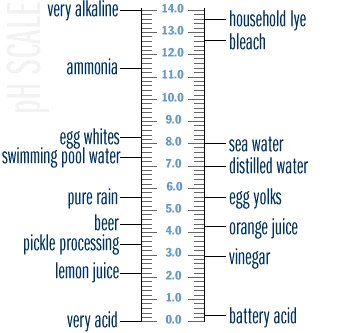
Get To Know The pH-Scale  Posted by Hello

Understand About landed in pH

I am totally ignorance about pH of Water & Drinking Water before I live in the USA.

Now, after all these years of research, I feel to it is important to share these knowledge with everyone, in view of the danger of these highly polluted world.

pH 7 have 10 times Hydrogen ion (H+) than pH 8

Remember, if your drinking water pH is 7 that is neutral.

By the continuous blog awareness & education then we can spreadhead about Clean & Safe Drinking & Applicable Water for your Great Health.


pH Why Is it Important?

The pH of a sample of water is a measure of the concentration of hydrogen ions. The term pH was derived from the manner in which the hydrogen ion concentration is calculated - it is the negative logarithm of the hydrogen ion (H+) concentration. What this means to those of us who are not mathematicians is that at higher pH, there are fewer free hydrogen ions, and that a change of one pH unit reflects a tenfold change in the concentrations of the hydrogen ion. For example, there are 10 times as many hydrogen ions available at a pH of 7 than at a pH of 8.

The pH scale ranges from 0 to 14.

A pH of 7 is considered to be neutral.
Substances with pH of less that 7 are acidic;
substances with pH greater than 7 are basic.


ph scale

The pH of water determines the solubility (amount that can be dissolved in the water) and biological availability (amount that can be utilized by aquatic life) of chemical constituents such as nutrients (phosphorus, nitrogen, and carbon) and heavy metals (lead, copper, cadmium, etc.). For example, in addition to affecting how much and what form of phosphorus is most abundant in the water, pH may also determine whether aquatic life can use it. In the case of heavy metals, the degree to which they are soluble determines their toxicity. Metals tend to be more toxic at lower pH because they are more soluble.

Reasons for Natural Variation

Photosynthesis uses up dissolved carbon dioxide which acts like carbonic acid (H2CO3) in water. CO2 removal, in effect, reduces the acidity of the water and so pH increases. In contrast, respiration of organic matter produces CO2, which dissolves in water as carbonic acid, thereby lowering the pH. For this reason, pH may be higher during daylight hours and during the growing season, when photosynthesis is at a maximum. Respiration and decomposition processes lower pH. Like dissolved oxygen concentrations, pH may change with depth in a lake, due again to changes in photosynthesis and other chemical reactions. There is typically a seasonal decrease in pH in the lower layers of a stratified lake because CO2 accumulates. There is no light for plants to fix CO2 and decomposition releases CO2.

Fortunately, lake water is complex; it is full of chemical "shock absorbers" that prevent major changes in pH. Small or localized changes in pH are quickly modified by various chemical reactions, so little or no change may be measured. This ability to resist change in pH is called buffering capacity. Not only does the buffering capacity control would-be localized changes in pH, it controls the overall range of pH change under natural conditions. The pH scale may go from 0 to 14, but the pH of natural waters hovers between 6.5 and 8.5.

Expected Impact of Pollution

When pollution results in higher algal and plant growth (e.g., from increased temperature or excess nutrients), pH levels may increase, as allowed by the buffering capacity of the lake. Although these small changes in pH are not likely to have a direct impact on aquatic life, they greatly influence the availability and solubility of all chemical forms in the lake and may aggravate nutrient problems. For example, a change in pH may increase the solubility of phosphorus, making it more available for plant growth and resulting in a greater long-term demand for dissolved oxygen.

Values for pH are reported in standard pH units, usually to one or two decimal places depending upon the accuracy of the equipment used.

Since pH represents the negative logarithm of a number, it is not mathematically correct to calculate simple averages or other summary statistics.

Instead, pH should be reported as a median and range of values; alternatively the values could be converted to hydrogen ion concentrations, averaged, and re-converted to pH values.

Generally, during the summer months in the upper portion of a productive or eutrophic lakes, pH will range between 7.5 and 8.5. In the bottom of the lake or in less productive lakes, pH will be lower, 6.5 to 7.5, perhaps. This is a very general statement to provide an example of the differences you might measure.

The Case of Acid Rain

An important exception to the buffering of pH changes in lakes is the case of lakes affected by acid rain. Lakes that have received too much rain with a low pH (acid rain), lose their buffering capacity. At a certain point, it takes only a small bit of rain or snowmelt runoff for the pH to change. After that point, change occurs relatively quickly. According to the EPA, a pH of 5-6 or lower has been found to be directly toxic to fish (for additional information, see our acid rain links).

Water on the Web | Understanding | Water Quality | Parameters | pH

Saturday, February 05, 2005

Fraternity pledge died from excessive water intake

Well, remmeber, everything there is a limit.

Just thing of it, why the earth is suspended in the emptiness??

Why, at certain time one would feel hungry or thirsty, who need to eat or drink at that particular time.

In the "I-Medical Sutra" the 5 eleements , Water, Wood, Earth, Metal, Fire must be balance, any element imbalance would cause illness & eventure death.

The other thing is, it is a common sense that once too much water in the stomarch, the body would react & there is more load for the Kidney & bladder. Once these two organs give way then obviously it death.

Therefore, for your Great Heath, Never Ever Drink Excessive Water.

Fraternity pledge died from excessive water intake, coroner says

BY KELLI PHILLIPS Knight Ridder Newspapers

CHICO, Calif. - (KRT) - Coroner's officials said a 21-year-old Chico State student died from the effects of over-consumption of water, complicated by low body temperature, during a fraternity initiation.

Matthew Carrington, who grew up in Pleasant Hill, died Wednesday morning trying to become a member of Chi Tau fraternity.

He had been up all night, drinking large quantities of water from a 5-gallon jug, doing push-ups and answering trivia questions about other fraternity members, said Chico police Sgt. Dave Barrow.

During the night, a fan was used to blow air on him, family members said.

Carrington suffered a seizure and stopped breathing.

"It was just more than he could handle," said Kristi Vahl, a longtime friend.

According to the Butte County Coroner's Office, the cause of death was cardiac dysrhythmia due to electrolyte imbalance from water intoxication. A contributing factor was environmental hypothermia.

Drugs and alcohol were not a factor, police said. No arrests have been made, but it will be up to the district attorney whether to file charges, Barrow said.

On Thursday, as fraternity and sorority "rush week" activities continued, Chi Tau members refused to comment on Carrington's death or their pledge activities.

A former Chi Tau member, who asked that his name not be used because he still attends Chico, said that during a 2002 Chi Tau pledge activity, he was forced to drink milk until he threw up.

"I think for some guys there's a pressure to please," said J.W. Dell'Orto, a member of the agricultural fraternity Alpha Gamma Rho. "Seems like the younger guys are trying to impress the older frat brothers. It's like being a freshman in high school and getting invited to a senior party. You want to show them you're up for it."

Dell'Orto, a senior majoring in animal sciences, said Alpha Gamma Rho doesn't haze new members. Instead they host a barbeque and interview pledge candidates.

Molly Priest, 22, one of Carrington's roommates, said he didn't complain about the pledge activities, which included standing against a wall for hours and dressing up like a female prostitute.

"They were pushed to their limits," Priest said. "And Matt was pushed too hard."

Students said the university and police have cracked down on fraternities and alcohol-related activities since a 18-year-old fraternity pledge from Palo Alto died in 2000.

"Everyone parties here, not just the Greeks," said Dani Jimenez-Cruz, of Lambda Theta Nu. "It's what you make of it. You don't have to party if you don't want to, but the temptation is definitely there."

Two weeks ago, an 18-year-old Chico student nearly died from alcohol poisoning during a Sigma Chi pledge activity that involved drinking two 1.75 liter bottles of vodka. Butte County prosecutors said Thursday they plan to file charges against the fraternity member who provided the alcohol.

On Thursday afternoon, Erin Bixon, of Foothill Distributing Inc., wheeled cases of Budweiser into Riley's bar, a popular hangout frequented by members of nearby fraternities and sororities.

"Some kids try to find their limits and see what they can take," he said.

KRT Wire | 02/04/2005 | Fraternity pledge died from excessive water intake, coroner says

Friday, February 04, 2005

NSF International Releases Final Report On Testing of Arsenic Treament Technologies

NSF is a Not-for-Profit Certification organization that research & report includes Water Contaminations & Drinking Water Safety standard..

The following press release is beneficial for all that concern about the Arsenic Treament in our Drinking Water System.

NSF Releases Final Reports on Testing of Arsenic Treatment Technologies

Helping Protect the Public from Exposure to High Levels of Arsenic in Drinking Water

(ANN ARBOR, MI USA) – To ensure drinking water technologies are available for consumers to reduce exposure to arsenic, the not-for-profit NSF International today announced the release of four final verification reports through the EPA/NSF Environmental Technology Verification (ETV) Drinking Water Systems (DWS) Center. These new reports were produced to specify testing results of drinking water treatment technologies that help consumers avoid exposure to arsenic, which can increase cancer risk and cause other serious health problems.

“These reports are an important step in protecting the public from arsenic exposure,” said Bruce Bartley, NSF’s technical manager in the ETV DWS Center. “By providing consumers with proven results of product evaluations, these evaluation reports accelerate the implementation of new drinking water technologies into the marketplace.”

The ETV DWS Center reports demonstrate a significant reduction of arsenic in drinking water. These tests were performed in small communities in three states in conjunction with Delta Industrial Services and the University of Alaska at Anchorage in Anchorage, Alaska; Watts Premier and MWH in Thermal, California; Kinetico, Inc. and Alcan Chemicals with Gannett Fleming in Carroll Township, Pennsylvania; and ADI International with Gannett Fleming in Sellersville, Pennsylvania.

In 2001, the U.S. Environmental Protection Agency (EPA) issued a new arsenic maximum contaminant level (MCL) of 10 micrograms per liter (µg/L). Since that time, public health officials throughout the United States have detected varying amounts of arsenic in many drinking water supplies, some well above EPA's new MCL. As of January 23, 2006, all public water systems will be required to comply with the 10 µg/L MCL.

With assistance through an EPA grant, NSF International entered into an agreement on October 1, 2000 with the EPA to form the ETV DWS Center. The ETV DWS Center is dedicated to providing independent performance evaluations of drinking water technologies and helping small communities comply with the 10 µg/L MCL.

The reports can be accessed at the following web pages:

Delta Industrial Services, Anchorage, Alaska Full Report: http://www.nsf.org/business/drinking_water_systems_center/pdf/Delta_Report.pdf

Watts Premier, Thermal, California Full Report:
http://www.nsf.org/business/drinking_water_systems_center/pdf/Watts_Report.pdf

Kinetico, Inc. and Alcan Chemicals, Carroll Township, Pennsylvania Full Report: http://www.nsf.org/business/drinking_water_systems_center/pdf/Kinetico-Alcan_ETV_Report.pdf

ADI International, Sellersville, Pennsylvania Full Report:
http://www.nsf.org/business/drinking_water_systems_center/pdf/ADI_Phase1_Report.pdf

“NSF expects the release of three additional reports on arsenic reduction technologies for drinking water in 2005,” concluded Bartley.

For additional information on these final reports, please contact Bruce Bartley at 1-800-NSF-MARK ext. 5148, (734) 769-5148, or bartley@nsf.org.
NSF International : Newsroom : News and Press Releases


CharlieBrown8989 aka Charlie Tan © 2006 - 2007 • all rights reserved